
What is the IELTS Speaking Test?
The IELTS Speaking test is a face-to-face conversation with a certified examiner that lasts between 11 and 14 minutes. It is the same for both IELTS Academic and IELTS General Training candidates. The test is designed to assess your ability to communicate effectively in spoken English — not to test your knowledge of a subject.
Your speaking test may take place on the same day as your other modules or up to 7 days before or after. It is recorded for quality assurance purposes.
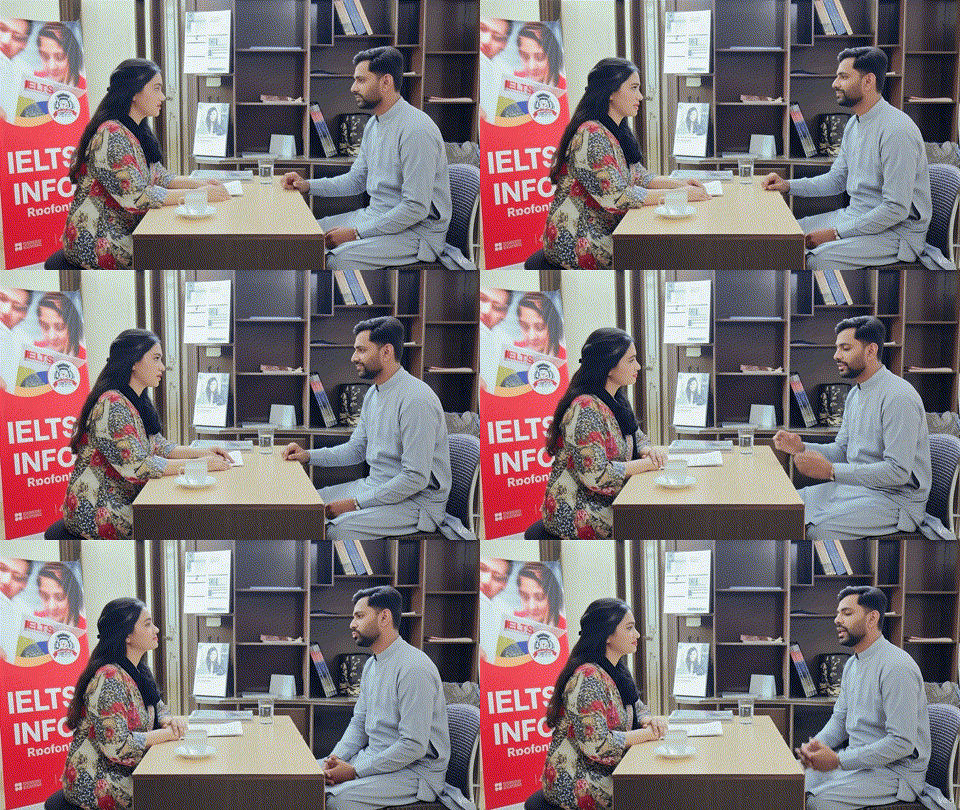
IELTS Speaking Test Format
The speaking test is divided into three parts:
Part 1 – Introduction & Interview (4–5 minutes)
The examiner introduces themselves and asks you to confirm your identity. You are then asked general questions about familiar topics such as:
- Your hometown and where you live
- Your studies or work
- Your hobbies and daily routine
- Family, food, travel, technology
What to aim for: 2–4 sentence answers. Give a direct answer, then add a reason or example.
Part 2 – Individual Long Turn / Cue Card (3–4 minutes)
You are given a task card (cue card) with a topic and 3–4 bullet points. You have 1 minute to prepare notes, then must speak for 1–2 minutes on the topic. The examiner may ask 1–2 follow-up questions.
Example Cue Card:
Describe a person who has had a positive influence on your life. You should say: – Who this person is – How you know them – How they influenced you – And explain why you consider them an important influence
What to aim for: Organise your 1 minute of preparation time well. Cover all bullet points. Speak clearly and confidently without memorising a script.
Part 3 – Two-Way Discussion (4–5 minutes)
The examiner asks more abstract and analytical questions related to the Part 2 topic. These questions require you to give opinions, compare ideas, and discuss issues in depth.
Example questions (based on the Part 2 topic above):
- “Do you think teachers or parents have a stronger influence on children?”
- “How has the role of mentors changed in modern society?”
- “Do you think celebrities are good role models for young people?”
What to aim for: Express opinions clearly. Use phrases like “In my opinion…”, “I think it’s fair to say…”, “On the one hand… but on the other hand…”
IELTS Speaking Band Descriptors
Your speaking test is marked on four criteria, each worth 25% of your speaking score:
| Criterion | What It Measures |
|---|---|
| Fluency & Coherence | How smoothly and logically you speak |
| Lexical Resource | Range and accuracy of your vocabulary |
| Grammatical Range & Accuracy | Variety and correctness of sentence structures |
| Pronunciation | Clarity, intonation, and word stress |
Important: You do NOT need a British or American accent. Pakistani English is perfectly acceptable. Focus on being clear, not sounding foreign.
IELTS Speaking Topics 2026
IELTS refreshes its speaking topics three times per year. For the current January–April 2026 cycle, common topics include:
Part 1 Topics: Home & Hometown | Work & Study | Technology & Apps | Food & Cooking | Health & Fitness | Travel & Places | Nature & Environment | Clothes & Shopping | Education
Trending 2026 Cue Card Topics (Part 2):
- Describe a person who inspires you to learn new things
- Describe an app you find useful in daily life
- Describe a time you faced a tough challenge
- Describe a place in nature you have visited
- Describe a decision that changed your life
- Describe someone you know who has a good sense of fashion
- Describe an unusual meal you had
- Describe a popular place for sports you have visited
New 2026 Themes Appearing in Part 3:
- Artificial Intelligence and its impact on society
- Remote work and its effects on productivity
- Sustainable living and environmental responsibility
- Mental health awareness in modern life
Top 10 IELTS Speaking Tips
1. Don’t memorise scripts Examiners are trained to detect rehearsed answers. They will ask unexpected follow-up questions to test whether your response is natural. Prepare ideas and vocabulary — not word-for-word answers.
2. Extend your answers naturally Never give one-word answers. Always follow the AREA method: Answer + Reason + Example + Alternative/Extension.
3. Use a range of vocabulary Instead of saying “good,” say “beneficial,” “rewarding,” “worthwhile,” or “invaluable.” Vary your word choices throughout the test.
4. Use linking words Connect your ideas smoothly: “Furthermore,” “As a result,” “Having said that,” “What’s more,” “In contrast.”
5. Don’t worry about pausing Natural pauses are fine. Use fillers like “That’s an interesting question,” “Let me think about that for a moment,” or “Well, to put it another way…” to buy thinking time.
6. Correct yourself naturally If you make a mistake, correct it calmly. This actually demonstrates grammatical awareness to the examiner.
7. Vary your sentence structures Use a mix of simple, compound, and complex sentences. Use conditionals (“If I had the chance…”), relative clauses (“…which is something I’ve always enjoyed”), and passive voice where appropriate.
8. Practice speaking English daily Record yourself on your phone answering cue card topics. Listen back and identify weaknesses in fluency, vocabulary, and pronunciation.
9. Prepare for abstract Part 3 questions Part 3 requires critical thinking. Practice discussing two sides of an issue. Read news articles and form opinions on education, technology, environment, and social issues.
10. Focus on pronunciation clarity Work on word stress, syllable emphasis, and intonation patterns. Even one or two unclear sounds per sentence can affect your pronunciation score.
Common IELTS Speaking Mistakes to Avoid
- Speaking too fast due to nervousness
- Giving very short answers (1–2 sentences only)
- Using the same vocabulary repeatedly
- Starting every answer with “Yes, I think…”
- Going off-topic in Part 2
- Stopping abruptly before 1 minute in Part 2
- Using overly formal language (this is a conversation, not an essay)
How The Academy of IELTS Prepares You
At The Academy of IELTS, our speaking preparation programme includes:
- 1-on-1 mock speaking tests with examiner-trained trainers
- Recorded feedback sessions so you can hear your own performance
- Cue card banks with 200+ practice topics
- Pronunciation coaching tailored to Pakistani English speakers
- Weekly speaking circles for group conversation practice
- Part 3 discussion workshops on trending topics including AI, environment, and education
Our trainers are certified and experienced in helping students across Pakistan achieve Band 7+ in speaking.
Frequently Asked Questions
Q: Is the IELTS Speaking test the same for Academic and General Training? Yes. Both versions use the same speaking test format and are marked identically.
Q: Can I ask the examiner to repeat a question? Yes. You can politely ask the examiner to repeat or clarify a question without any penalty.
Q: What if I don’t know anything about the cue card topic? You can use general ideas and personal experiences. You are being tested on your English, not your knowledge.
Q: How soon after the test are speaking results available? Speaking scores are typically available with your overall results, 3–5 days after a computer-based test or 13 days after a paper-based test.
Q: Can I change my answer in Part 1? Yes. You can correct yourself or change your answer naturally. This is actually a positive sign to the examiner.
Ready to improve your IELTS Speaking score? Book a free speaking assessment with The Academy of IELTS today.
[Book Free Assessment] [Contact Us]